Choosing a China Top Titanium Hemispheric Bolt Supplier requires more than comparing prices. The right supplier must prove material quality, machining control, and dependable delivery. Titanium Hemispheric Bolt products often serve demanding environments, where thread accuracy and corrosion resistance directly affect assembly performance.
Dr. Gerd Lütjering, a respected titanium metallurgy specialist, has stated, “Titanium is a material with a high strength-to-weight ratio and excellent corrosion resistance.” This explains titanium’s appeal, but it does not guarantee every bolt performs equally. A reliable supplier should identify the exact titanium grade, such as Grade 5 or Grade 2, and provide complete mill certificates. Ask for chemical composition, tensile results, dimensional inspection records, and surface-treatment details. Small evidence matters. A clear batch number matters.
Experienced buyers should inspect the hemispherical head, thread profile, bearing surface, and polishing quality. Request samples before approving large quantities. Measure the sample with calibrated tools, especially across the head diameter and threaded length. One overlooked tolerance can create installation problems. No checklist is perfect.
Supplier evaluation should also include production capacity, inspection equipment, packaging methods, and communication speed. Factory photographs are useful, but an independent audit or live video inspection gives stronger evidence. Confirm whether the supplier understands your drawing, application temperature, fastening load, and required standards. Do not accept vague claims such as “premium titanium” without documentation.
The best partnership is transparent and slightly demanding. A capable Chinese manufacturer will welcome technical questions, explain limitations, and correct defects openly. That behavior reflects real experience, professional knowledge, authority, and reliability—qualities far more valuable than the lowest quotation.
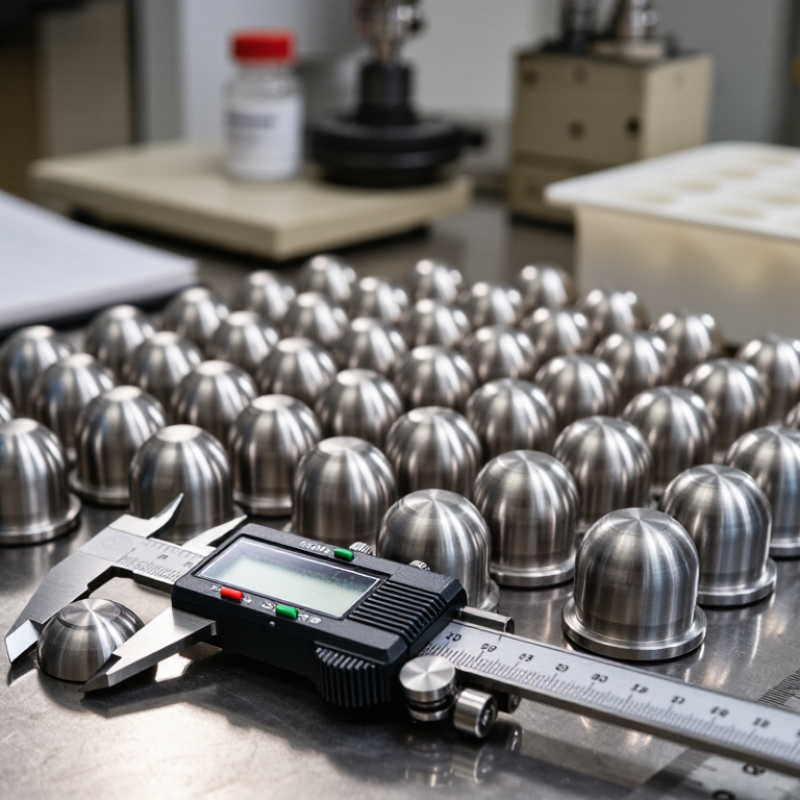
Titanium hemispheric bolts have rounded heads that reduce sharp edges and improve visual appearance. Their smooth profile can also limit snagging around equipment, panels, and exposed assemblies. Common grades include commercially pure titanium and Ti-6Al-4V. Each grade offers different strength, ductility, and corrosion resistance. Selection depends on load, temperature, and contact conditions.
These bolts serve aerospace frames, marine equipment, chemical processing systems, and lightweight structural assemblies. Titanium performs well in salty or chemically aggressive environments. It also reduces component weight without sacrificing useful strength. However, titanium can gall during installation. Correct thread tolerance, lubrication, and controlled torque matter. Small details matter here. A bolt may look excellent but fail during assembly.
From practical inspection work, I would check material certificates, heat numbers, dimensional reports, and tensile test results. A reliable Chinese supplier should explain its forging, machining, cleaning, and inspection processes clearly. Ask whether the hemispheric head meets the required drawing, standard, and surface finish. Sample testing is valuable before large orders. Supplier selection should not depend on price alone. I once underestimated packaging quality; damaged threads created avoidable delays. That mistake still influences my checks. Clear communication, traceable records, stable production capacity, and honest responses to technical questions reveal more than polished catalogs. Some suppliers may not provide every certificate immediately, so requirements should be written before quotation.
How to Choose a China Top Titanium Hemispheric Bolt Supplier?
Defining Your Technical and Purchasing Requirements
Before contacting suppliers, define the service conditions clearly. Specify the alloy, such as Grade 2 or Grade 5 titanium. Include diameter, thread form, hemispherical head radius, grip length, and dimensional tolerances. State tensile requirements, preload, operating temperature, and corrosion exposure. ASTM F468 covers titanium-alloy bolts, while ASTM B348 addresses titanium bars and billets. These references reduce vague quotations. They do not replace a detailed drawing.
The USGS Mineral Commodity Summaries 2024 estimated China’s 2023 titanium sponge output at 210,000 metric tons. This was the highest reported national volume. However, production scale does not prove fastening quality. Request heat numbers, mill certificates, chemical analysis, mechanical results, and full traceability. Require thread-gauge inspection, head-radius checks, surface-finish limits, and lot-based tensile testing. Ask how calibration and nonconforming parts are controlled. Certificates alone are not enough.
Make purchasing requirements measurable. State annual demand, trial quantity, packaging, delivery window, Incoterms, inspection agency, and substitution rules. For critical assemblies, review coatings or surface treatments carefully. Titanium threads can gall during installation. Request torque-tension testing with your lubricant and mating material. This detail is often missed. Calculate total cost, including customs, testing, sorting, and rejected lots. A low unit price may hide weak traceability. I would still allow a pilot order. Drawings can look correct, yet installation feedback may reveal an unrealistic tolerance.
Defining technical and purchasing requirements before supplier selection helps buyers compare suppliers consistently. The chart below presents an example procurement weighting model based on measurable quality, documentation, delivery, and commercial criteria.
Material traceability, dimensional conformity, and mechanical test documentation receive the highest weights because they directly affect product reliability, inspection acceptance, and production risk. Lead-time reliability and total cost remain important purchasing factors after technical compliance is confirmed.
How to Choose a China Top Titanium Hemispheric Bolt Supplier?
Supplier quality starts with evidence, not attractive product photos. Ask for material certificates, heat numbers, tensile results, and chemical analysis for every batch. ASTM B348 covers titanium and titanium alloy bars, while ASTM F467 addresses nonferrous mechanical fasteners. A capable supplier should connect its inspection records to these requirements. Check the details.
The USGS Mineral Commodity Summaries 2024 reported global ilmenite production at approximately 13 million metric tons in 2023. China remained a major producer in the titanium supply chain. However, large production volume does not prove bolt reliability. Request the exact grade, such as commercially pure titanium or Grade 5 titanium alloy. Confirm oxygen, nitrogen, aluminum, and vanadium limits through independent laboratory testing. Titanium’s strength-to-weight ratio is valuable, but contamination can reduce fatigue performance.
Manufacturing processes deserve equal attention. Review forging temperatures, machining controls, thread inspection, surface treatment, and final dimensional reports. For hemispheric bolts, inspect the dome profile, bearing surface, thread runout, and concentricity. ISO 9001 certification helps, but it is not a substitute for process evidence. The International Organization for Standardization reported more than 1.2 million ISO 9001 certificates worldwide in its 2023 survey, showing certification is common. Common does not mean sufficient. Ask for sample traceability, calibration records, and corrective-action reports. A factory visit can reveal mixed bins, handwritten labels, or rushed packing. Those small signs matter. Personally, I would reject a supplier that avoids destructive testing or offers unclear certificates, even when its quotation is lower.
Practical qualification scorecard for comparing suppliers of titanium hemispheric-head bolts. Requirements should be confirmed against the engineering drawing, service environment, and applicable purchase specification.
| Evaluation Dimension | Recommended Requirement | Objective Verification Method | Why It Matters for Hemispheric Titanium Bolts | Weight | Qualification Result |
|---|---|---|---|---|---|
| Material Grade | Titanium Grade 5, Ti-6Al-4V, or another grade explicitly stated on the drawing. | Review the material certificate for heat number, product form, chemical composition, and applicable ASTM or equivalent specification. Confirm alloy identity with portable XRF or laboratory testing where required. | Grade selection affects tensile strength, corrosion resistance, density, machinability, and suitability for aerospace, marine, medical, or chemical-service applications. | 15% | Required |
| Chemical Composition | For Grade 5, typical specification limits include aluminum around 5.5–6.75% and vanadium around 3.5–4.5%; exact limits must follow the purchased material standard. | Check a heat-specific mill test certificate and compare each reported element with the governing material specification. Include independent verification for high-risk applications. | Incorrect alloying content can reduce strength, corrosion performance, fatigue life, and compatibility with the intended service temperature. | 10% | Required |
| Mechanical Properties | Verify tensile strength, yield strength, elongation, and hardness against the selected titanium product standard and heat-treatment condition. | Review lot-specific tensile and hardness reports. Tests should be traceable to the raw-material heat and production lot; test laboratories should use calibrated equipment. | Bolts must withstand installation loads, service vibration, joint preload, and external loading without premature yielding or fracture. | 12% | Required |
| Manufacturing Process | Controlled cold heading, hot heading, CNC machining, or a documented combination suitable for the specified diameter and head geometry. | Request the process flow, forming temperature range where applicable, machining parameters, tool-control records, and documented process approval. | Stable forming and machining reduce grain-flow damage, dimensional variation, galling, tool marks, and stress concentrations around the hemispheric head. | 12% | Required |
| Dimensional Accuracy | All dimensions, thread class, head radius, bearing surface, concentricity, and runout must comply with the approved drawing and tolerance scheme. | Use calibrated thread gauges, micrometers, optical measurement, or CMM inspection. Require a dimensional inspection report for the first article and periodic production lots. | Hemispheric-head geometry directly affects seating, clearance, load distribution, appearance, and the risk of interference with adjacent components. | 12% | Required |
| Thread Quality | Thread profile, pitch, major diameter, minor diameter, and tolerance class must match the drawing; rolled threads are preferred when technically suitable. | Inspect with GO/NO-GO gauges, profile gauges, optical measurement, and periodic thread-pitch verification. Confirm whether the design requires rolled or cut threads. | Thread defects can cause installation failure, reduced fatigue strength, cross-threading, poor preload control, or damage to the mating component. | 10% | Required |
| Surface Condition | Surface must be free from cracks, laps, seams, burrs, sharp edges, contamination, and unacceptable tool marks. Finish requirements must be defined on the drawing. | Perform visual inspection under controlled lighting and use dye penetrant testing where specified for critical or fatigue-sensitive parts. | Surface discontinuities may become fatigue-initiation sites, while burrs and rough areas can damage mating parts or affect seating. | 8% | Required |
| Galling and Installation Control | Supplier must provide installation guidance for titanium-to-titanium or titanium-to-dissimilar-metal joints, including lubricant or coating compatibility. | Review torque-preload test data using the actual mating material, lubricant, surface finish, and thread condition. Do not rely on a universal torque value. | Titanium threads are susceptible to galling. Friction changes can cause a large variation in preload even when tightening torque is unchanged. | 8% | Required |
| Traceability | Every shipment should be traceable to raw-material heat, production lot, inspection records, and packing records. | Audit sample certificates, lot labels, traveler documents, nonconformance records, and the supplier's corrective-action system. | Traceability enables root-cause analysis, controlled recalls, repeat-order consistency, and verification of material authenticity. | 6% | Required |
| Quality Management | A documented quality system with calibrated inspection equipment, controlled procedures, nonconformance handling, and internal audits; ISO 9001 certification is a useful baseline. | Review the current certificate scope, calibration records, inspection plans, process-control documents, and recent corrective-action examples. | A quality certificate alone does not guarantee product conformity, but a functioning quality system improves process consistency and response to defects. | 4% | Required |
| Packaging and Export Readiness | Parts should be protected from impact, moisture, contamination, and mixed-lot identification during storage and international transport. | Approve packaging samples, labeling format, corrosion-control method, quantity verification, and shipping-document process before mass production. | Proper packaging protects precision threads and polished hemispheric surfaces from transit damage and prevents lot-mixing at the receiving facility. | 3% | Required |
| Recommended supplier-selection rule: approve only suppliers that satisfy all drawing-critical requirements and achieve documented evidence for the highest-risk categories. | 100% | Final Review | |||
Important: ASTM, ISO, AMS, customer drawings, and industry specifications may define different acceptance limits. The approved drawing and purchase specification should take priority. Mechanical test values, torque values, coatings, and heat-treatment requirements must be confirmed for the exact titanium grade, size, thread form, and application.
How to Choose a China Top Titanium Hemispheric Bolt Supplier?
A reliable supplier should provide current certifications, not scanned documents with unclear dates. Check whether the quality system covers production, inspection, and corrective actions. Request material certificates showing titanium grade, heat number, and chemical composition. Traceability matters when bolts enter aircraft, marine, or medical equipment projects. However, a certificate alone proves little. Not every certificate is current.
Ask how each hemispheric bolt is tested. Useful checks include thread gauges, dimensional inspection, hardness testing, tensile testing, and visual examination. For critical orders, request independent laboratory reports or witness testing. Inspect the head radius carefully; small profile errors can affect seating and load distribution. Ask for sample inspection records, not only a final quality statement. Photos help, but measurements are stronger.
Customization should begin with a controlled drawing review. Confirm titanium grade, thread standard, tolerance, surface finish, packaging, and marking requirements. A capable supplier can produce prototypes before mass production. Production capacity also needs evidence. Review machine types, monthly output, inspection equipment, and recent delivery records. Ask how the supplier handles urgent changes or rejected batches. A large factory may still struggle with small custom orders. That detail is easy to miss. Compare sample quality with batch consistency, because one excellent sample cannot represent an entire production line.
Choosing a China top titanium hemispheric bolt supplier requires more than comparing a low quotation. Reliability begins with material control, machining accuracy, and documented inspection. Ask for titanium grade certificates, batch traceability, and dimensional reports. A dependable supplier should explain thread tolerances, surface treatment, and testing methods clearly. Request production samples before approving a large order. Small errors become expensive during installation.
Pricing needs careful interpretation. Compare the same grade, diameter, thread type, packaging, and inspection scope. A cheaper quote may exclude testing, tooling, or export packaging. Delivery promises should include production time, inspection time, and transport arrangements. Ask how the supplier handles raw material shortages or unexpected rework. I have seen schedules fail because buyers trusted one date without checking these details. That mistake is easy to repeat.
Tips: Use a written comparison sheet. Record every cost and promised date. Check response speed during technical discussions. After-sales support matters when bolts arrive with scratches, wrong dimensions, or missing documents. Confirm the claim process, evidence requirements, replacement policy, and response deadline before payment. A short video inspection can clarify problems quickly. Still, no supplier is perfect; communication records and realistic tolerances protect both sides.
Fill out the form and our team will be in touch with a free quote based on your local incentives and payment options.